Role of Yoga in Education

Yoga is nothing but a scientific system of physical and mental practices that originated in India more than three thousand years ago and its purpose is to help each one of us for  achieve our highest potential and to experience enduring health and happiness. Using Yoga, we can improve  healthiness of our body and by that quality of our lives become better.

Here am saying about the role of Yoga in educational institution. The benefits of Yoga is to have stress-relieving powers on students, paying the way for improved academic performance with the practice of  various asanas, meditation and breathing exercises. It is found that Students talked of decreased stress levels and being more at peace to study, resulting in an increase in their academic performance. So Yoga education helps in self-discipline and self-control, leading to immense amount of awareness, concentration and higher level of consciousness in students. So yoga must be included in the curriculum as a compulsory subject. Some of our educational institutions are already included this in their curriculum. But one category of people still thinks that it is related to one particular religion practice so they are negating. This mindset of people should change. Researches shows that the children who were practicing yoga in the classroom saw a great improvement in their responses, creativity, memory, willpower and behavior. These children were more relaxed, focused, and one-pointed than others who were not practicing yoga and who were more destructive, restless, violent and distracted.

So these results shows that Yoga must be included in the school curriculum which will improve the responses and behavior of students.

Reference

Ilana Palgi. (2007). Our Story of Yoga: Participatory Learning and Action with Young Children. Children, Youth and Environments,17(2), 329-340. Retrieved from http://www.jstor.org/stable/10.7721/chilyoutenvi.17.2.0329
  

Student or Learner Centered Curriculum


 In Learner or student centered curriculum the center of interest is the learner. The students have more importance in this type of curriculum design. Now a day’s most of the education experts as well as others are in favor of student centered curriculum.

 First of all Educational expert Rousseau emphasized that education should be according to the interests of the child. Learner should be provided a free and democratic environment. The interest of the child should be a basis for the curriculum design. Learner centered design also emphasizes individual development and their approach to organizing the curriculum merges from the needs, interests and purposes of students. Student-centered learning mainly focuses on, acknowledging student voice as central to the learning experience. In a student-centered learning space, students can choose what they will learn, how they will learn, and how they will assess their own learning which is in contrast to traditional education. In teacher-centered learning here teacher the teacher will be primarily active role while students take a more passive role. In a teacher-centered classroom or curriculum teachers choose what the students will learn, how the students will learn, and how the students will be assessed on their learning. In contrast, student-centered learning requires students to be active as very responsible participants in their own learning and with their own pace of learning which the major difference. There is also subject centered curriculum as an example spiral curriculum. The spiral curriculum here is organized around the material to be taught, and more emphasis on the concepts and ideas.

So now a days compared to teacher centered and subject centered curriculum all are looking forward to student centered curriculum.

Reflection on My First Experience as an Intern Teacher

Here this reflection is about the first phase internship happened at Christ academy ICSE school Bengaluru. My teaching subject was physics and i got 7th B grade for teaching and it was a very active class. The portion I got was Heat (chapter 5) and around 80 percent of the portion already taught in the class. So student’s response was not that good and initially I asked them some questions and they were mass answering. So initial response was that they already knew many things. But later that class I understood actually only few of them knew the answers and rest of them are silent. Then I gave them one activity which containing a bunch of pictures of different substances and they have to classify them according to their wish and mention the criteria on what basis that classification is done. But the students were little confused since I failed to give instructions properly even classroom was little noisy but some talented students immediately identified the corresponding categories and classifies in to two categories. My personal reflection on this is that learning will happen more by doing things rather than hearing some lecture so they will remember the activity so they won’t forget the classification with examples. So even though the classroom was little noisy the reaction towards this activity saying that student are really interested. After this activity ma’am want to distribute some answer sheets to students and she took the remaining time and most of them had scored average marks. So again I founded that even though students are answering when we ask questions they may forget in the exam and May doesn’t understand the concept in practical manner etc.

The next class for this was on Thursday 6th period. Before that my thinking was how to deal with children in the next class since they already did the lesson. So I thought of doing something different like flipped class room, word cloud, concept mapping etc. to be introduced in the class. So that in a different way of teaching I can go forward with lesson. So I discussed this thing with my elective faculty Dr Prakasha GS and came to know that for lower classes this kind of teaching won’t be practical. These things can understand easily only by adult learners. Then he suggested to strictly follow the lesson plans since our aim is to improve our teaching and learning process. So I prepared for the next class and went on that day regular teacher there for me was absent she asked one senior faculty to supervise my class. I did the portion of conversion of Celsius scale to Fahrenheit scale as well as Kelvin scale. After the theory class I solved two problems and give them one homework. Here this class also little disturbed because that period was actually mend for music period but the teacher adjusted for me for taking the class. So students were also felling distracted and on the half way part one teacher took around 15 students from class for some Christmas program practices. Another thing happened was the teacher who came for evaluating my class sit only for 10 minutes and then he went for some other purposes. Lastly he given me supervision sheet with lot of comments. Class room managing was the serious problem I faced here again. After that class teacher gave me some note books for correction purpose. By reading the notebook I could see that full notes from beginning to end was given. All the exercises problems are solved. Some students wrote everything neatly some others made some simple mistakes which I corrected. Last two classes on Thursday and Friday I took the remaining topics conduction, convection, radiation and thermos flask. In that only for one class supervisor was there. So in total I got only 3 supervision sheets. At the end I got lot of books for correcting which I feel in the beginning teacher does not know me properly but after two weeks she was ready to give me tasks. But I feel two weeks was very short time to understand the whole school scenario.

The school assembly which happened every day which I didn’t mentioned here the sports day programs, Christmas celebrations practices which all proved that the school is given equal importance to non curricular activities as well. There were periods allotted specially for non-curricular activities in the time table itself. The transportation we had towards this school was also in a school bus every day which was also really interesting. I was travelling in school bus for first time (since my school was very near to my home) and also half of the bus was filled with teachers it was great experience for me. One noted point was that during school assembly happening there was questionnaire club and they will ask current affair’s to each grade students for those who answering will get one green card which will added to the grades at the end. Also the assembly was happened in English, French and Hindi also they had speaking club which they will select one random topic and five minutes speech will happen after that. The birthday celebration of teachers as well as students will also happen this time. All these were new experiences to me during this first internship.

Advantages of Continuous Comprehensive Evaluation (CCE) in Schools

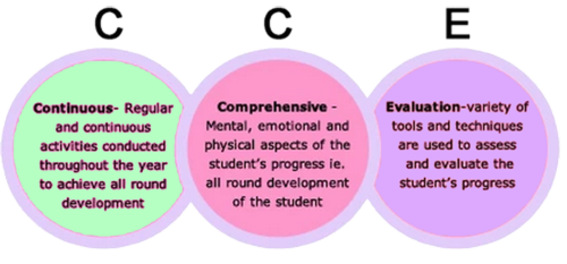
Continuous and Comprehensive Evaluation (CCE), is an education system recently introduced by CBSE, found its main aim in the overall evaluation of the learners. It was formulated to do away with the exam-centric approach which was very common in our evaluation system.

                                        Continuous and Comprehensive Evaluation (CCE) aimed to bring the focus on developing all aspects of an individual’s personality development. The cognitive, affective and psychomotor skills of learners, though recognized as vital aspects in learning, had somewhere evaded the exam oriented education system. The main aim of CCE was to evaluate every aspect of the child during their presence at the school like curricular as well as non-curricular together. This is believed to help student reduce the pressure during or before examinations as the student will have to sit for multiple tests throughout the year. The CCE method is claimed to bring lot of changes from the traditional method of teaching, provided it is implemented accurately. Here also if the student was not able to perform well in one pattern of evaluation he or she is getting other chances for improving. One examination won’t determine the capability of student.

As a part of this CCE system, student’s marks were replaced by grades which were evaluated through a series of curricular and extra-curricular evaluations along with academics and the ultimate aim was to decrease the workload on the student by means of continuous evaluation by taking number of small tests throughout the year in place of single test at the end of the academic program. So in conclusion we can say that there are lot of advantages of using CCE in school level students.

Importance of Motivation in School Education Environment


Here we can see how the concept of motivation in school education environment affects the learning process of students.Motivation is nothing but the reason for peoples action, willingness and goals. Lack of motivation in education can be one cause that may affect the process of their learning. As an example if one student scored nice marks he should be appreciated so that it will motivate the child for further improvement at the same time if one student getting less marks don’t demotivate that student but encourage them with motivational talk. All students, including teachers, are motivated in different ways and forms. In the motivational aspect, the role of teachers in the educational process is the creation of a good climate and a positive attitude that encourages learning and their long-term success. The role of students is getting good knowledge and be active in order to increase their academic skills. Increasing collaborative learning and communication skills between student and teacher are two basic factors of motivation for learning process. Collaborative learning will help students to know each other, share their knowledge which will motivate others at the end. Communication skills are again very much important tool for increasing the motivation. In a school education scenario if we discourage any student that will make impact on children which will affect their entire carrier. So motivation is very much important in this global context. Children’s will remember the teachers whomever motivated them in any bad situation so motivation will help the mental health of the child.

So in conclusion i can say that Motivation is very importance factor for children’s in school education scenario and it may be inspiration come from others or it may come from with in the individuals.